
Considering Violence
A road trip through southern New Mexico

A bullet, tearing through skin. The bruising thud of a baton. A fist slamming mercilessly against the hard bone of a jaw. A battlefield, stained with blood.
What is violence?
The June sun beats down on the roof of a silver sedan as it races down US-54 in southern New Mexico. Inside, the air conditioner is cool as I gaze out the window while my partner drives, eyes fixed on a road that continues north until it disappears into the horizon. Up ahead, a structure emerges in the distance, standing alone in the middle of the open desert. My partner takes his foot off the gas, slowing the vehicle as orange traffic cones on the black pavement narrow the road from two lanes to one. They guide us towards the large pavilion whose sheet metal awnings arch over the highway. Standing next to a small building under the shade of the checkpoint, a man in an olive green uniform is leaning forward to speak to the driver of a red car in the line in front of us.
Camera after camera
lined up like crows perched on a fence
Eyes peering in through windows,
through skin,
down to the bone
Who sits on the other side, watching?
Cámara tras cámara
alineadas como cuervos posados en una valla
Ojos mirando a traves de una ventana,
de la piel,
hasta el hueso
¿Quién está viendo
al otro lado?
We pull up to the front of the line. My partner lowers the window, and the man in olive green leans down to look in his car.
“All US citizens?”
“Yes sir,” we both reply.
He pauses, then steps back to peek into the windows of the back seat. He sees our hiking backpacks, caps, cowboy hats. A water bottle covered in travel stickers. He nods, then waves us ahead. As we pull forward, I look to my right to see that the driver of the red car has been pulled to the side of the checkpoint. It is a woman, maybe in her 30s, sitting on a bench while two more men in green say something to her inaudible to my ears. As she speaks, she waves her hands around her face, fingers fluttering desperately like injured birds.
What is violence?
In many ways, violence is something that feels so easily definable that questioning it may appear absurd. As children, we are taught about the violence of physical conflict between individuals. Perhaps we witnessed it in fights between other children on the playground, or in media depicting the adventures of soldiers, cowboys, police, and war heroes. Some are unfortunate enough to have first experienced violence within their own home, against themselves or between family members. And so our earliest and most common understanding of violence is often that which is both physical and interpersonal, making it seemingly easy to identify.
This past week the topic of violence is one that has been thrown around quite a bit, beginning with protests against ICE raids in Los Angeles and into the weekend of “No Kings” demonstrations against President Trump’s birthday and military parade. After President Trump sent 2,000 National Guardsmen to LA without approval from California Governor Gavin Newsom, both White House Press Secretary Karoline Leavitt and Secretary of Defense Pete Hegseth voiced their support for the decision by asserting that it was made to address the “violent mobs” supposedly attacking ICE officers [1]. In the days leading up to the more than 2,000 organized “No Kings” protests across the country, city and state leaders emphasized the need for demonstrations to remain nonviolent.
The way the concept of violence is deployed so easily in public discourse, particularly when it comes to justification for certain governmental action, one would think that its definition is as clear cut as the yellow lines between lanes on a highway. But who gets to decide what qualifies as violence? And who benefits from these varying definitions?
These questions I thought about as we continued our journey north, deeper into New Mexico. The first stop on our daytrip was the Three Rivers Petroglyph site, located about five miles off the highway into a recreation area under the jurisdiction of the Bureau of Land Management. There, a hiking trail follows the hilltop created by a basaltic ridge line whose dark black rocks are etched with over 21,000 petroglyphs. The rock art was created by the Jornada Mogollon, a culture which disappeared in the 15th century before the Spanish arrived in the American southwest [2].
At the highest part of the ridge, we look down and see the vast valley known as the Tularosa Basin, walled in on either side by the Sacramento Mountains to the east and the San Andres Mountains to the west. Once, roving bands of Apaches established temporary villages on the basin floor, moving between mountains and valleys to hunt and gather as the seasons changed [3]. Their nomadic lifestyle was impeded first by Spanish colonization, then later by the arrival of American settlers who were attracted by the promise of fertile agricultural land. After 1848, forts were established across the American southwest to protect Anglo settlements from raids, and the series of conflicts between the US military and various bands of Apaches in the New Mexico and Arizona territories became known as the Apache Wars [4,5].
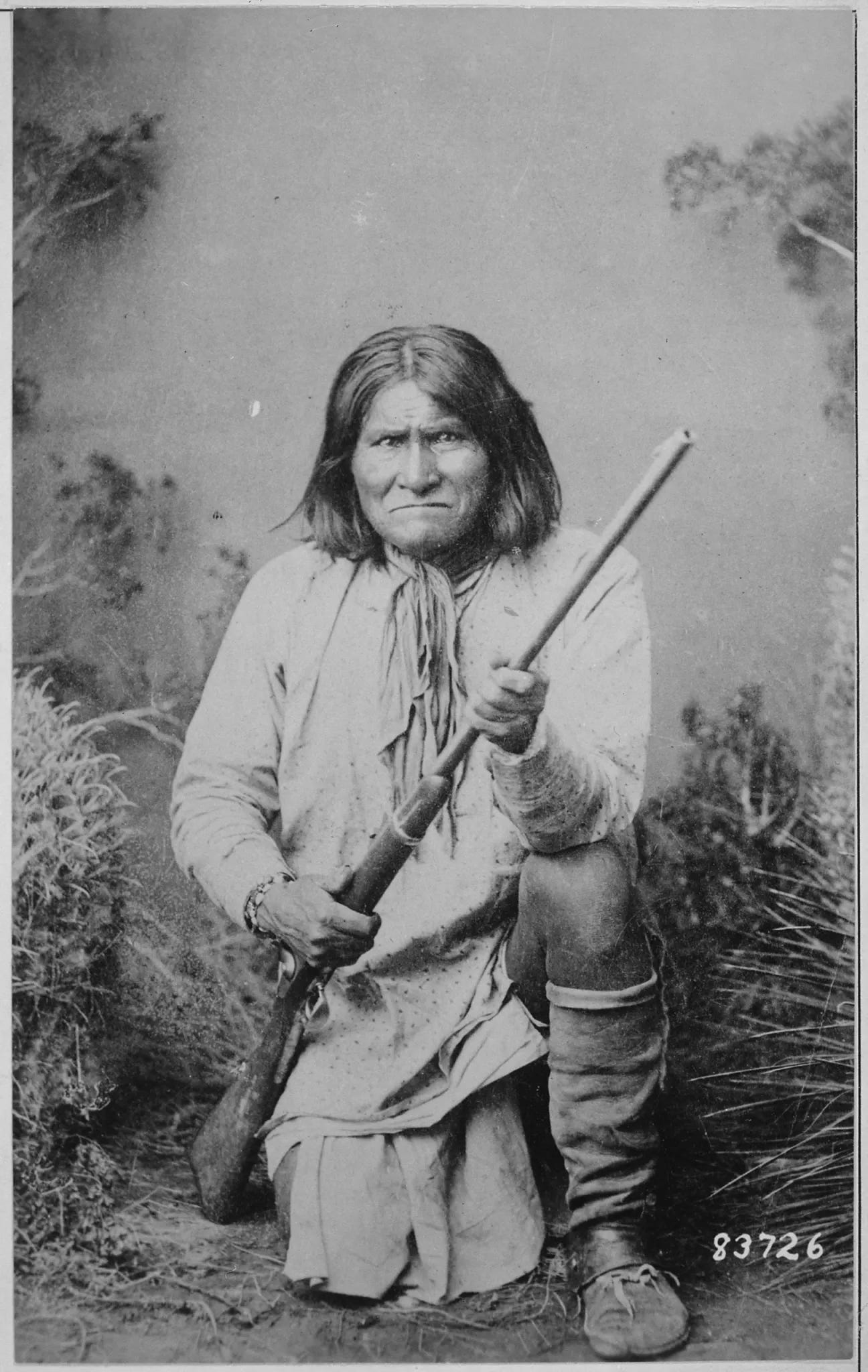
In the Tularosa Basin, leaders like Victorio and Geronimo engaged in battle with Buffalo Soldiers, fighting against their forced relocation into reservations like the Mescalero Reservation, which was founded near Fort Stanton up in the Sacramento Mountains. Victorio was killed in 1880 by Mexican soldiers after being driven into the Tres Castillos mountains, just south of El Paso [6]. Geronimo surrendered in 1886 to Brigadier General Nelson Miles, who promised him that his people would be able to return to their land after a period of exile in Florida. This never came to pass, and after being forced to do hard labor in Florida the Apache were sent to Fort Sill in Oklahoma, where Geronimo spent the last years of his life as a prisoner of war and tourist attraction in traveling Wild West shows [7]. He is quoted on his deathbed as saying, “I should never have surrendered. I should have fought until I was the last man alive” [8].
Prisoners,
savages,
here comes riding
the Devil on horseback
Eastward, a cage is calling,
but to the west
the lovely land calls louder
There is no snake as venomous
as the one under the boot
Prisioneros,
salvajes,
ahí viene
el Diablo a caballo
Al este, una jaula llama,
pero al oeste
la tierra linda llama más fuerte
No hay serpiente tan venenosa
como la que está bajo la bota
As we sit on a bench at the highest part of the basaltic ridge, I think about the former town of Three Rivers, where at the entrance to the road for the petroglyph site, a lone gift shop stands in the wind. It is the Three Rivers Trading Post, in a historic adobe building on the side of the highway. Earlier, we stepped inside and were greeted by a friendly older white woman at the register and an eccentric assortment of Native American-inspired art and collectibles. There were t-shirts printed with “Indian blanket” patterns, real projectile points and pottery sherds in a glass case, and paintings of serene landscapes dotted with teepees and anonymous people dressed in buckskin riding horses. In the very back, a brown mannequin with long hair dressed in a leather vest and cotton pants sat quietly, empty eyes fixed on the floor.
What is violence?
In 1969, Norwegian sociologist Johan Galtung argued for an “extended concept of violence” in his article “Violence, Peace, and Peace Research” [9]. Instead of traditional understandings of violence as the physical incapacitation of an individual by an actor, he argued:
“…violence is present when human beings are being influenced so that their actual somatic and mental realizations are below their potential realizations.”
This is to say that violence is what occurs when there is an avoidable difference between a person or population’s potential level of physical and mental wellbeing and their actual level of physical and mental wellbeing. Galtung gives examples of violence as poverty in rich countries, death by curable disease, misogyny, racism, and even certain kinds of indoctrination. He identifies the condition of social injustice as itself structural violence.
Since Galtung’s article, countless social scientists and theorists have since expanded the discourse about what violence is, and how it is utilized against humans and nonhumans. While my understanding of violence has certainly evolved over my lifetime, I do not claim to have a better or newer definition at this moment in my academic career. What I do know is that in learning the patterns of history, you can also learn to read the scars that violence has left etched into a landscape.
The sun has passed its zenith as we depart from Three Rivers. At Carrizozo, we eat lunch at what seems to be the only open restaurant in town before turning off US-54 onto US-380. About 4 miles in, the road cuts through the Malpaís Lava Flow, an area of desert covered in pitch black volcanic rock that stretches 125 square miles [10]. On satellite imagery, it looks like a dark lake just northeast of White Sands, making for an extraordinary contrast of color in a relatively small region. Malpaís is the Spanish word for badlands, and was used to refer to areas whose hostile topography was too difficult to cross on horseback. Here, it was the rocky crags of black vesicular basalt that made the lava flows a death trap for travelers unfamiliar with the terrain.
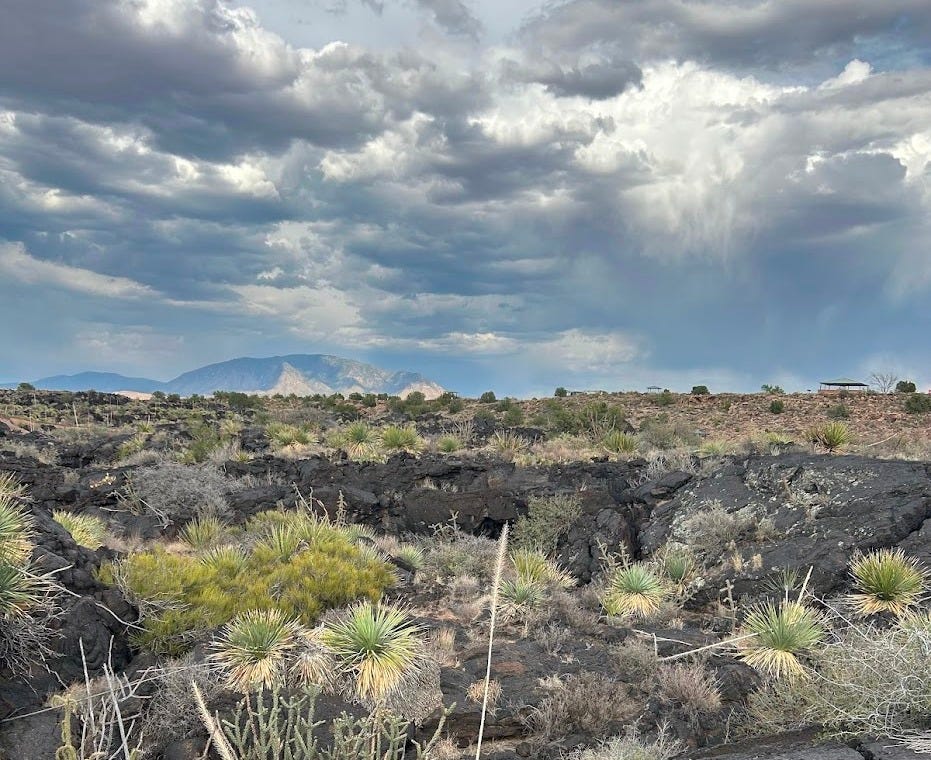
But this isn’t the first time parts of New Mexico had been written off as wastelands. US-380 transects a north-south portion of the state known as the Jornada del Muerto, or Journey of the Dead. With mountains blocking the Rio Grande to the west, the Spanish saw this portion of the Camino Real de Tierra Adentro as deadly to traverse for its absence of water and treacherous lack of refuge from the desert heat. Of course, they did not take into account the generations of indigenous peoples which occupied and traveled through the region for centuries before their arrival. But to strangers from the Old World, this journey was indeed one only for the dead.
There is no one but us on the highway now. We have left most of the traffic behind on 54, and there is not a single car for miles, only the road stretching into the abyss of desert before us. For a while we are quiet, taking in the emptiness, until suddenly my partner points to the left side of the road and exclaims, “Historical marker!”
Sure enough, a small brown sign has materialized seemingly out of nowhere, and with no one around he pulls over so that we can see what the sign says. There is no structure attached to the sign- no building, not even ruins. Only a road leading off the highway, invisible to us until we stopped to look at the sign. As we get closer, we gasp as we read the words: “TRINITY SITE.”
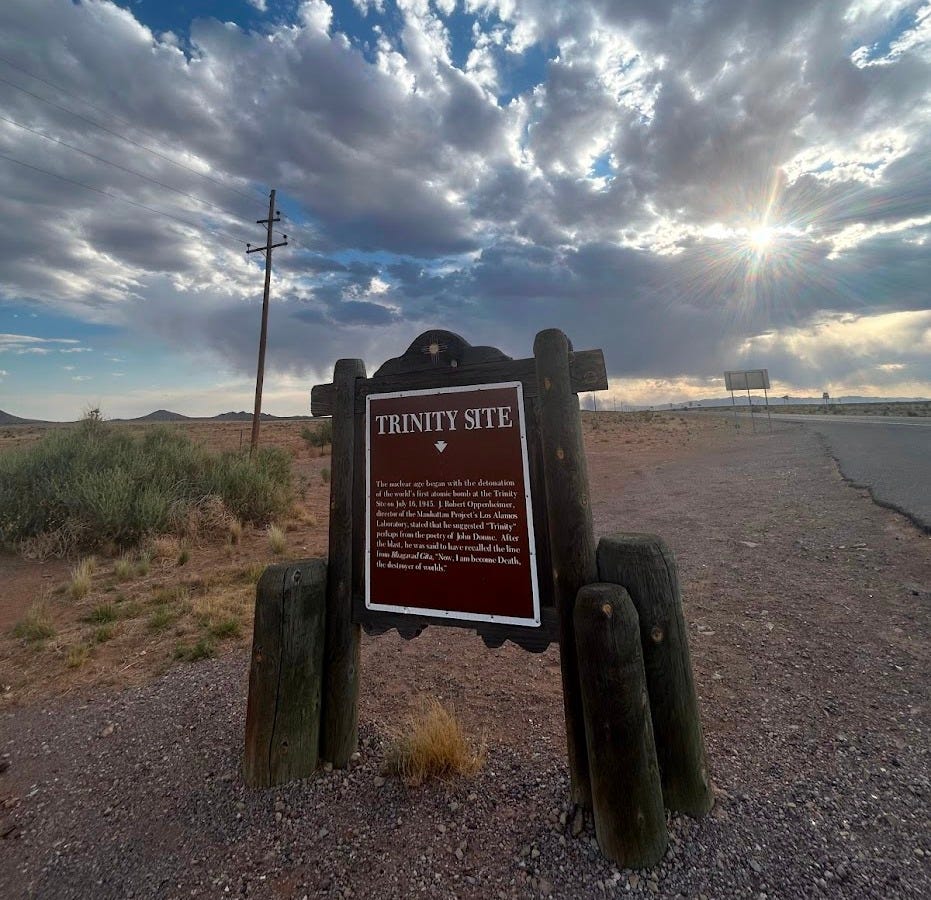
For a moment we are shell shocked, then almost laugh at the sheer oddity of it. I knew that the Trinity Site was located in southern New Mexico on the White Sands Missile Range, but I didn’t know there was an entrance to it here, not even an hour outside of Carrizozo. It feels strange to me, that after a lifetime of trekking this state with family and friends that something so immense was hiding here right under my nose.
A quick reference to Google Maps shows us that the road leads into the missile range for about 16 miles, ending at a circular indentation in the ground which I can only assume to be the exact spot where the very first atomic bomb went off. With no gate or sign to deter us, we decide to get back in the car and set off on a detour to see how close we can get to it.
Rolling slowly over a cattle guard and into the fenced area, we only make it about three miles before we are stopped by a gate next to which is a security booth, a US Army logo, and a smattering of loud caution signs. One warns of the danger of unexploded ammunition in the desert. Another indicates the unlawfulness of using drones. Seeing a man in a truck parked next to the gate, we take it as our cue to turn around and return to the main road.
And yet, we cannot stop thinking about how close we came to the site- and how innocuous it all looked. And yet is was innocuous by design; Oppenheimer chose the Trinity Site in the Jornada del Muerto for its apparent isolation and barrenness, a quality European settlers and explorers had described the region with for centuries [11]. But just as the Spanish were mistaken about its absence of life before, so were the scientists of the Manhattan Project, for at the time of the explosion nearly half a million people lived in a 150-mile radius of the test site [12].
When the bomb went off just before dawn, most people were still asleep. In Ruidoso, a group of young girls camping in a cabin were awoken by the blast, and upon seeing the white fallout raining from the sky, ran outside to play in it like snow. All except one died before age 30.
All in all, 19 counties, 78 towns, and dozens of pueblos and ranches were located within the downwind area of the blast. The CDC reported in 2010 that the radiation levels of these areas was 10,000 times higher than the acceptable level for public areas. No evacuation efforts were made, nor were New Mexicans made aware of the test until news of the atomic bomb’s use in Hiroshima was announced.
Today, the Jornada del Muerto is quiet on US-380. For the most part, residents of the surrounding cities and towns no longer remember the Trinity test, except for elders and the children who tell their stories. My father says his grandfather saw it, on his way to work early in the morning. He thought the sun was coming up, only to realize that dawn rose again, a few hours later.
¿Qué le falta a la tierra
para que se convierta en un malpaís?
Y los extraños siempre verán
lo desconocido
y dirán
que no vale nada
What is missing from the earth
that it becomes a badland?
And a stranger will always see
the unknown
and say it is worth
nothing
For most, violence remains a thing one actor inflicts upon another. Perhaps it is a punch to the gut, a slap to the face, or a soldier killing another in battle. But in New Mexico, violence is also constant surveillance, and the implied threat of knowing from the faceless powers that be. It is the forced removal from one’s home, and the labeling of “savage” towards those who sought to defend it to the death. It is the classifying of land as worthless and barren, useful only as a space upon which to practice death and destruction. The process by which some types of violence are legitimized while others are delegitimized is a classic exercise of power. Yet perhaps the most insidious violence is the one that tells you it is not violence at all, but rather only a procedure, or even worse- a necessary evil. This is the one that stands quietly at the door at an immigration court hearing, that sneaks away into the night with a signature on a cursed treaty, that presents itself as pure as snow but burns upon touching the skin.
Like the lonely highways of New Mexico, the road to peace is a long one. But peace cannot be accomplished without first understanding what is not peace, and how violence can be disguised as either peace itself or the means to achieve it.
As I finish writing, news is breaking that the United States has bombed three Iranian nuclear facilities [13]. President Trump said in a statement that further action will be taken “if peace does not come quickly.”
Indeed, for the good of all humanity, we hope that it does.
Further Reading
This entry’s reading recommendation is Johan Galtung’s “Violence, Peace, and Peace Research” which can be found at this link.
Citations
[1] Jeong, H. (2025, June 7). Trump sending National Guard to counter anti-ICE protests. NBC Los Angeles. https://www.nbclosangeles.com/news/local/trump-sending-national-guard-to-la-in-response-to-anti-ice-protests/3718088/
[2] Three Rivers Petroglyph Site. (n.d.). Bureau of Land Management. Retrieved June 22, 2025, from https://www.blm.gov/visit/three-rivers-petroglyph-site
[3] Apachean - White Sands National Park (U.S. National Park Service). (n.d.). National Park Service. Retrieved June 22, 2025, from https://www.nps.gov/whsa/learn/historyculture/apachean.htm
[4] Opler, Morris Edward and Catherin H. Opler. "Mescalero Apache History in the Southwest." New Mexico Historical Review 25, 1 (1950). https://digitalrepository.unm.edu/nmhr/vol25/iss1/2
[5] Alexander, K. (n.d.). Apache Wars of the Southwest. Legends of America. Retrieved June 22, 2025, from https://www.legendsofamerica.com/apache-wars/
[6] Editors. (2009, November 16). Chiricahua Apache leader Victorio is killed south of El Paso, Texas | October 15, 1880. History. https://www.history.com/this-day-in-history/october-15/chiricahua-apache-leader-victorio-is-killed-south-of-el-paso-texas
[7] Kratz, J. (2022, November 22). Geronimo, Apache Chief. Pieces of History. https://prologue.blogs.archives.gov/2022/11/22/geronimo-apache-chief/
[8] Geronimo - Apache, Death & Birthplace. (2021, March 26). Biography. https://www.biography.com/political-figures/geronimo
[9] Galtung, J. (1969). Violence, Peace, and Peace Research. Journal of Peace Research, 6(3), 167–191. http://www.jstor.org/stable/422690
[10] Valley of Fires Recreation Area. (n.d.). Bureau of Land Management. Retrieved June 22, 2025, from https://www.blm.gov/visit/valley-fires-recreation-area
[11] Manhattan Project: The Trinity Test, July 16, 1945. (n.d.). US Department of Energy: Office of History and Heritage Resources. Retrieved June 22, 2025, from https://www.osti.gov/opennet/manhattan-project-history/Events/1945/trinity.htm
[12] Blume, L. (2023, July 17). Collateral damage: American civilian survivors of the 1945 Trinity test. Bulletin of the Atomic Scientists. https://thebulletin.org/premium/2023-07/collateral-damage-american-civilian-survivors-of-the-1945-trinity-test/
[13] NBC News. (2025, June 22). U.S. bombs three Iranian nuclear sites, Trump addresses nation: Live updates. NBC News. https://www.nbcnews.com/world/middle-east/live-blog/israel-iran-conflict-rcna214241
It’s amazing how our American landscapes resonate both peace and violent memories. History is so important so as to remind us of who we are and where we come from. Great article.
I enjoyed reading this 🫶I had never heard that definition of violence being what is below potential wellbeing, but that is such an important thing to understand the ways violence gets erased or normalized by not being labeled precisely what it is. id love to hear your thoughts on Geronimo’s quote saying he should’ve fought to the death - does violence necessitate violence in resistance? Also props on the thorough citations.