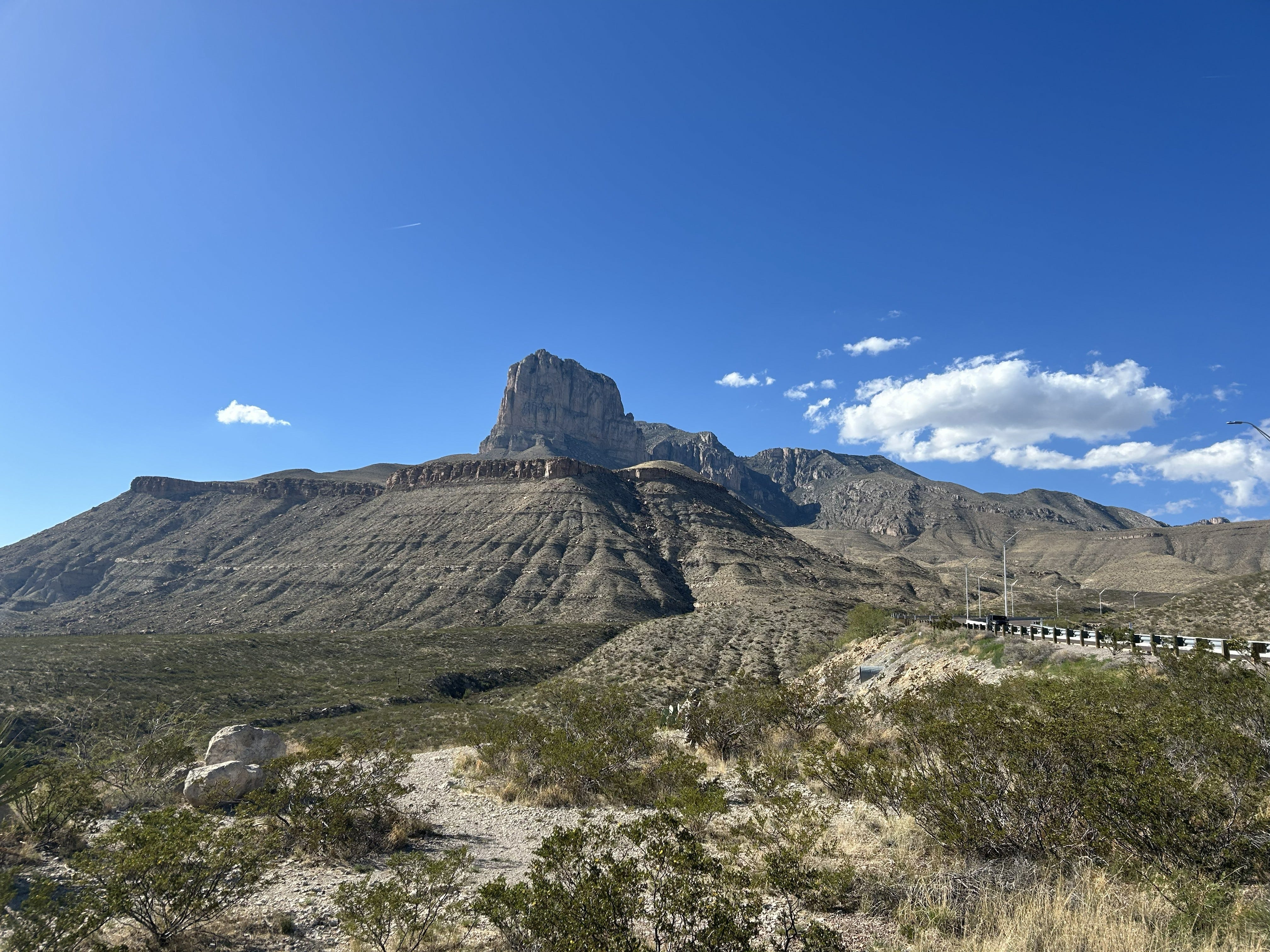
On Mountain Time
Journals from the Top of Texas

“It’s mesmerizing to look at, the rock. Like the mountain is in motion,” a hiker near Guadalupe Peak tells me.
He sits resting on a white rock as Tristan, Brock, and I take our last break before attempting the final scramble to the summit. This is our third or fourth time seeing him on the trail since we first met him in a cluster of pines back in the last canyon. He is an older gentleman, and friendly, with wispy silver hair hiding under a cap with flaps around the ears for sun protection. He is hiking with two poles to steady himself, but seems energetic as can be, keeping pace with my small group most of the way up.
I hope I am like him, when I am older. Or maybe like the older woman, accompanied by two men of a similar age we have leap frogged on the trail a few times now. They are all wiry and tanned, the whites of their teeth shining brilliantly against their bronzed wrinkled skin as they smile and greet us along the path. I look at their group, also one woman and two men, and am hit with an uncanny feeling that we have encountered ourselves from the future.
It is impossible to not think of time in the mountains.
I first came to Guadalupe Mountains National Park as a child, to hike McKittrick Canyon with a school group. It was the first time I had ever seen real fall foliage, the orange and red kind that I had before then only found in movies and Nat Geo magazines. While the basin below the mountains was dry and flat for miles, there in the canyon was an oasis of oaks, madrones, and other tough deciduous trees, growing in such dense clusters I could almost forget that I was in a desert at all. Next to the trees, a small creek of ice-cold water ran over a bed of sharp stones, right past a log cabin built by a lone rancher in the 1800s. I dipped my hand in the creek and couldn’t believe how a place known for such violent heat could also produce such coolness.
I return almost a decade later and just a few inches taller. My hair is the longest it’s ever been, and I bleached portions of it for the first time ever the weekend prior. My glasses are now round (as opposed to square) and I have just wrapped up the final assignments of my second college degree.
The mountain has not changed, or at least, not in any way I can see. When we set up our tents in the Pine Springs campground two nights ago, I wandered the nearby trails and found comfort in being surrounded by the same plants I remember from my childhood spent hiking in the Chihuahuan Desert - soaptree yucca, globemallows, lechugilla, Apache plume. I spot an alligator juniper and remember the first time my father beckoned me to touch its bark, textured like the reptile leather I once felt on a pair of Tony Lama boots at Starr Western Wear. I thought of Edward Abbey’s words upon returning to Lake Powell for the first time in decades: “Though much has been lost, much remains.”
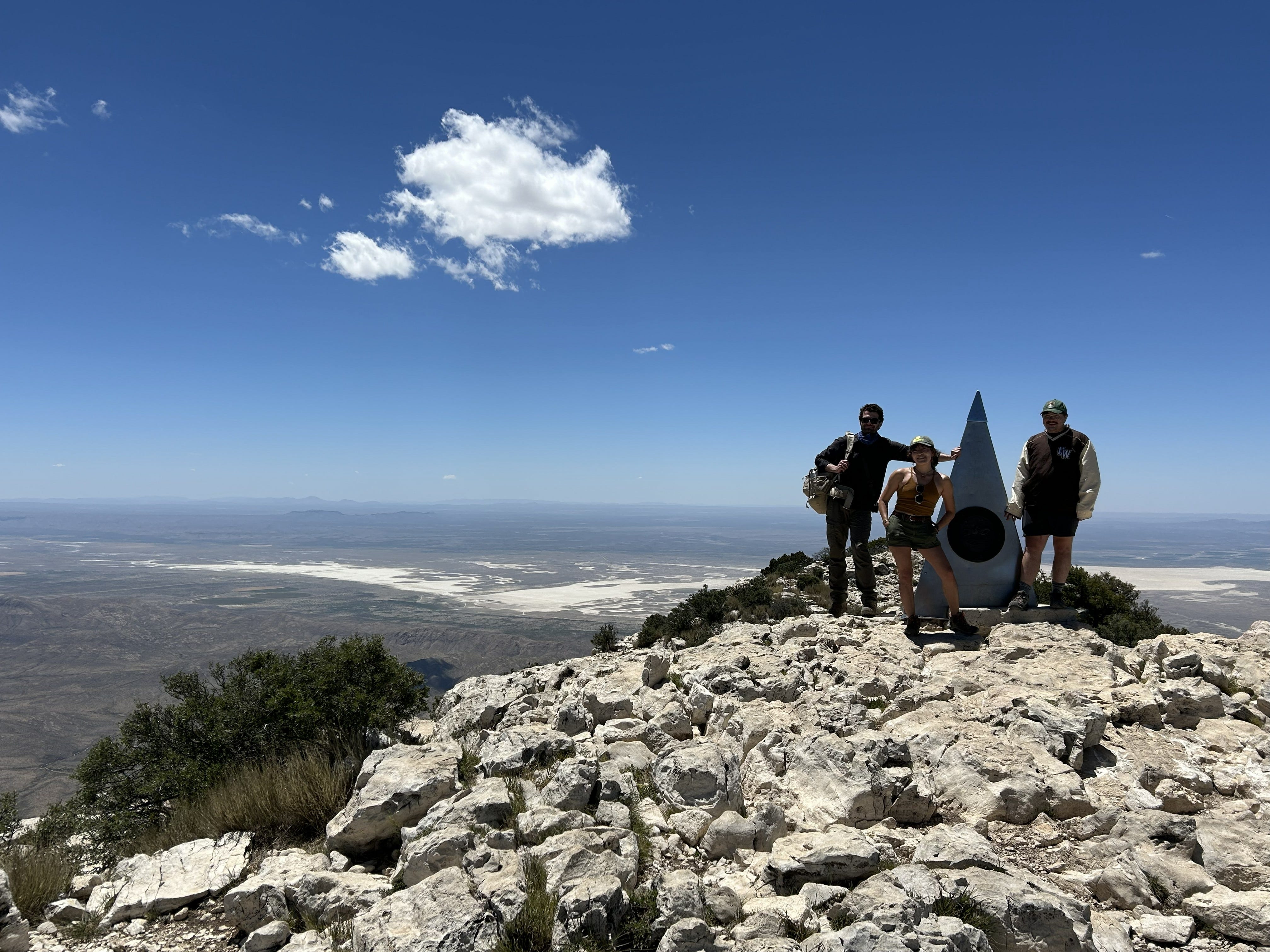
Though we had come to the park with the intention of summiting Guadalupe Peak, the hike to the top was harder on my body than I’d like to admit. Being born in a mountain desert town, I’d prefer to say that I finished the 8.4-mile trail with ease, that I reached the summit without having broken a sweat, that my lungs were unaffected by the 3,000-foot elevation gain and sharp gusts of wind. Yet my pride in pressing on where others had turned back was tinged with something else, a feeling in my gut that grew louder as the climb down made my head ache and a pain in my ankle grow more acute with every step. I had realized about two thirds up to the peak that though I had filled both my one-liter bottles at the trailhead, I had not brought with me nearly enough water to drink as much as I needed, and so found myself rationing one bottle for the entire way up and the second for the way down. Shortly after crossing a wooden bridge overhanging a sharp ledge on the hike back, I suddenly felt the trail I was walking on tip a full 30 degrees to my left, as if the mountain were a chessboard being folded up and I was a pawn tumbling off of it. I kneeled on the white rocks of the path, calling out in alarm to Tristan walking in front of me as I was momentarily overcome by a wave of vertigo, terrified I might actually careen off the path and plunge down into the canyon below. When the feeling passed, I moved to sit under the shade of a nearby juniper, and at the boys’ direction took an ibuprofen for the pulsing headache I had ignored for the last half hour. Sipping on my second bottle of water with electrolyte powder in it, I felt frustrated and a little embarrassed that my body was not in a condition to go at the pace my spirit intended.
I felt less ashamed at my slowness a few meters further into the down-hike when Brock’s foot slid out from under him on the loose gravel and hit a large rock at a painful angle. Together we sat on the side of the trail to recover while the pines danced around us, rustling as if they were laughing mischievously at our predicament. Thought it had seemed for a moment that we might back it back to our campsite faster than the 8 hours predicted by the map at the park visitor’s center, with two out of three in our party limited to walking at about half our normal speed, it became apparent that our trek would end on no one’s time but the mountain’s.
Treaty Oak Revival blasts on the speakers of Brock’s Tacoma as we drive south on US 285, away from Guadalupe Peak and back towards San Marcos. The diverse patchwork of high desert flora found in the park has melted away, leaving only the hardiest shrubs that can tolerate the dry gravelly sand and full sun of the Permian Basin. Under an overcast sky that seems to be equal parts cloud and dust, the desert stretches in every direction as far as the eye can see, interrupted only by the assemblage of power lines, pumpjacks, and the occasional oil drilling rig rising above the basin like a sort of ugly industrial skyscraper. Libby points out the window at a flame burning somewhere in the middle distance, which at this length appears no bigger than a candle but I know to be closer to the size of a bonfire. She tells me that the flames are from oil companies burning off excess natural gas produced in the oil extraction process, a practice that warms the climate and worsens air quality. She tells me that companies choose to eat the environmental fines associated with flaring because it is cheaper than capturing the gases for storage and later use.
There are no cows or horses to count on this part of the drive, which is slower than the stretch on I-10 because of all the oil traffic. We are caught waiting at a four way stop behind a line of white oil vehicles, some recognizable as company trucks but others outfitted with such an assortment of lifts, ladders, and other trappings that they blur the line between beast and machine. As we roll slowly through another boomtown, I resign myself to instead counting the temporary houses built for oil field workers, which to me look more like storage units than sites of human habitation. All the while, the truck speakers continue blaring, the words of Sam Canty droning on between an aggressive electric guitar riff and a belligerently loud drum line, “…out here it gets lonesome, and out here it ain’t no fun, living in the desert and this unpredicted weather, and the forecast is prolly more sun…”
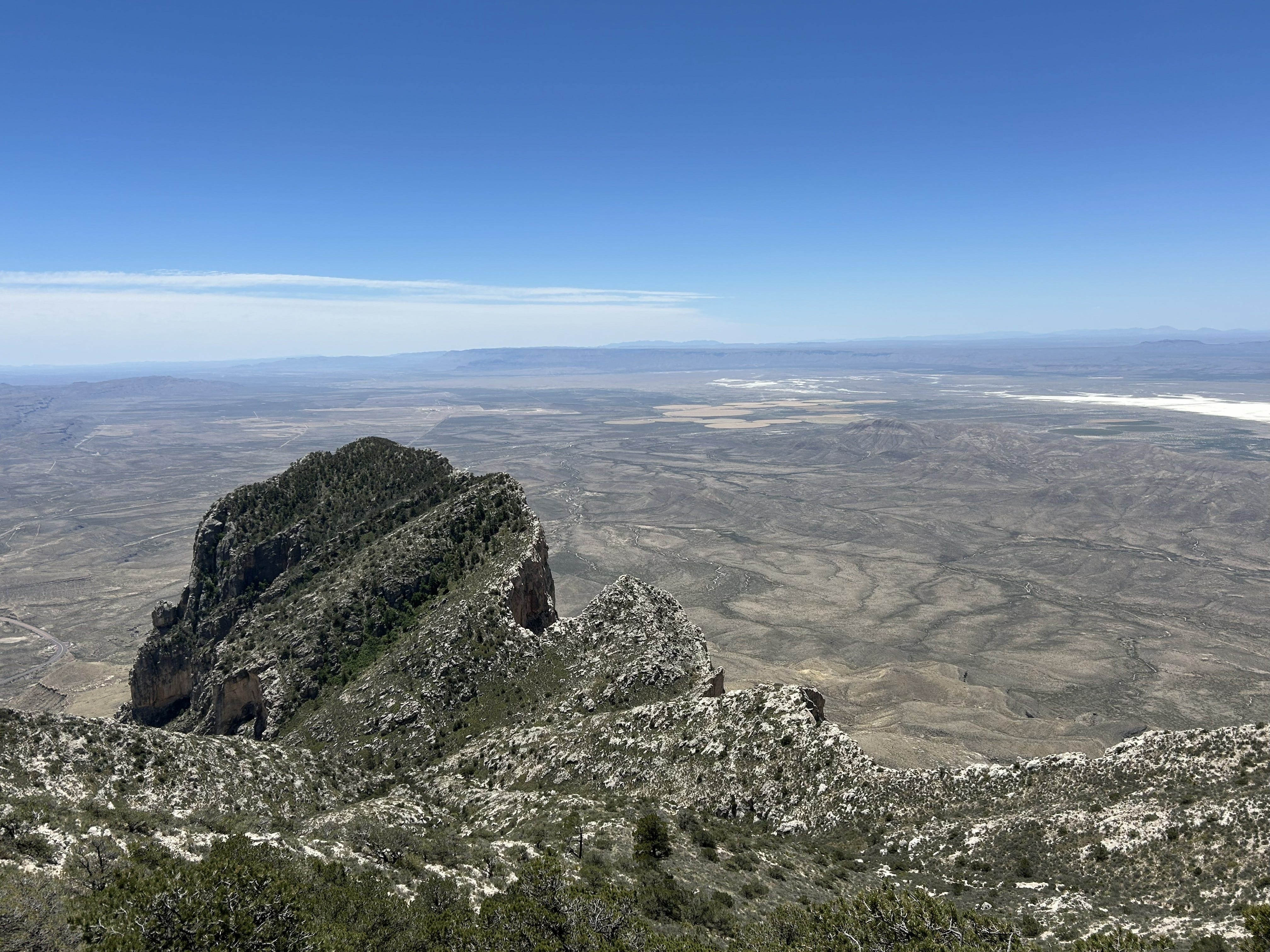
I couldn’t see the flares burning from Guadalupe Peak, though I did try and look for them. If driving through the Permian Basin on the way there did not solidify its flatness in my mind, it was certainly made clear looking down on it from more than 8,700 feet above sea level. The height had a way of flattening even the assortment of small mesas rising in the west, each crosscut by arroyos which curled around them like exotic pale serpents. Closer to the mountain but still far away lay the salt flats which were the subject of a short and bloody war over the precious resource in 1877. The salt is a remnant of an Ice Age lake that left behind bright white minerals like halite and gypsum after a warming climate evaporated the lake’s water. The dry playa formed 10,000 years ago, but remains absurdly young compared to the mountain, whose limestone outcrops began as a Permian era reef more than 260 million years ago. It is underlain by beds of sedimentary rock that formed in a shallow marine environment. The Delaware Sea, as it is now called, was home to many and strange organisms, whose decaying bodies transformed into the oil now being drilled by the many and strange machines dotting the basin for miles.
In this way the hike to Guadalupe Peak is as much a journey through time as it is over space, for through each of its false summits and sheer cliff faces, every step along the four-mile trek up and down represented a brief moment in the inconceivably long life of the great Chihuahuan Desert. To place my body at the peak, to stand sweaty and heaving at the place farthest from the sea and closest to the sun in the entire state, was to be only a comma in a story millions of years in the making.
I remember in one of my earliest geography classes, a professor told the class that a good geographer will by the end of their training be able to read land like pages of a book. Yet standing at the top of Texas, the landscape of my home desert spread out before me, how badly I wished to read the land not with my young geographer eyes but with the old ones of the mountain itself. What could be learned, if we possessed a mountain’s sense of time, if we could grasp its memories in our own two hands?
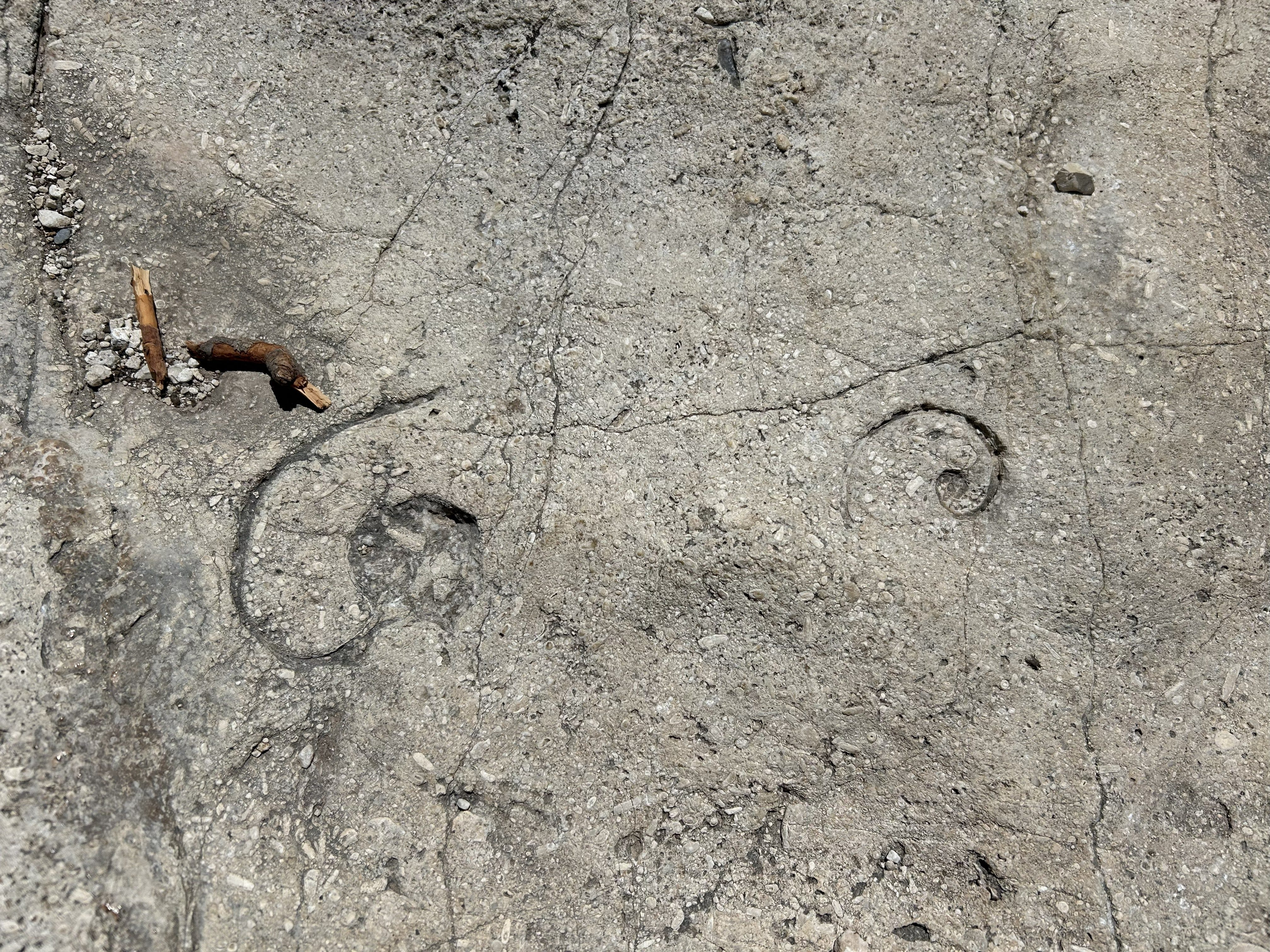
By my boots on the bright white stone of the peak, I noticed two crystalline spirals about the size of my palm - the fossilized shells of gastropods from the mountain’s stint as a massive reef. I thought for a moment of kneeling and pressing my ear to the rock, wondering if I was quiet enough I might hear the sound of tides crashing on an ancient shore, or a heartbeat pulsing like a current somewhere deep below my feet. Instead, I stood and gazed out into the horizon, listening to the wind whistling around the peak, each gust a whisper rising up from the desert floor.
Unlike our first and second nights in the park, our last night is a quiet one, almost eerily so. Though a small breeze plays through the junipers during our dinner of vegetables roasted in foil, by the time the sun sets there is almost no wind at all, the only sounds at camp being our own chatter and the gravel crunching beneath our shoes. The violent wind from the previous two nights seemed to have retreated to its native territory higher in the mountains, no doubt looking down on us with the eyes of a cougar who in its satiation had decided not to pursue a mule deer, even though it may walk within claws’ reach.
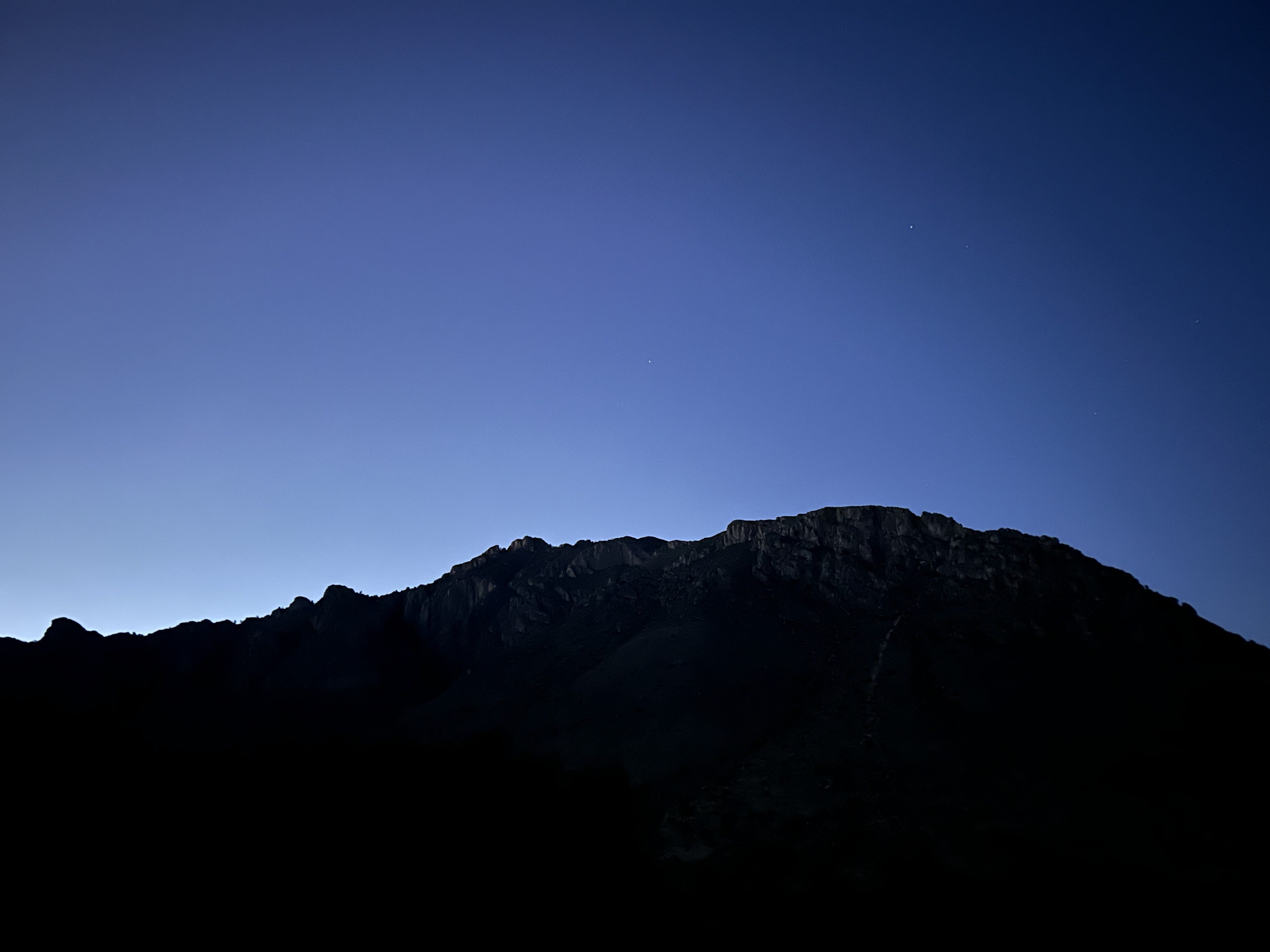
Taking advantage of the uncharacteristically still evening, for a while after darkness falls we stand around our picnic table, looking up at the stars sprinkled across the cloudless sky whose lights are rivaled only by those of the oil boomtowns and rigs glowing far off in the basin. When it becomes too cold to be comfortable standing outside (the park has not allowed campfires for years), we pile into Brock’s three-person tent to play cards by the light of a small solar powered lamp hanging from a hook on the tent ceiling. After two rounds of bullshit, Erin reaches up and turns the lamp off, plunging the tent into complete darkness to create a dramatic setting for telling ghost stories. As she speaks, telling tales of strange happenings and close encounters, I imagine her words floating up through the tent’s zippers and out from under the rain fly into the cool canyon air, our stories joining those of campers that have populated the mountain since time immemorial.
I very quickly lose track of what time it is, having lost the sun for reference and most of my phone battery along with it. Yet even with semi-charged phones, no one has been checking the time anyway. The park sits at an odd intersection of two time zones - everything south and east of the park borders remaining in Central and everything northwest in Mountain. If you look at a time zone map, the park forms an odd corner jutting out from where the New Mexico state line meets a meridian running north from Van Horn, interrupting what would otherwise be a perfect right angle. It’s for this reason that cellphones are unreliable time indicators in the park – always searching for the nearest connection, they rocket between displaying Central and Mountain Time as their internal transceiver is muddled by being so close to the place where the two zones touch.
And what point is there, anyway, in knowing the exact hour and minute in the mountains? Each time I go camping I am struck by how quickly the body adjusts to a timeless schedule, dictated not by a clock but by the rising and setting of the sun, compelled only to act in response to hunger cues and whether it is too cold or hot for movement. Though I am a notorious night owl back home, I am envious of the person I become in places without clocks – how easily I rise shortly after dawn and how quickly I am ready to sleep after sunset. How productive I could be, if my only work was to live in this beautiful world.
As our speech grows softer and slower in the tent, I bask in the tired yet happy voices of my friends, not knowing the next time we will all be together in such a place again. Sitting, feet tucked under my knees on the soft cushion of my sleeping bag, I know only that I am content to pass the unmeasured hours of the evening here with them, huddled as we are in our polyester cocoon, while the silhouette of the mountain outside deepens from lavender to indigo and finally to black. Tomorrow we will again reach a place with reliable service, and I will be met with a backlog of unread emails and text messages from friends, family, and coworkers. But here, the black womb of our little tent is staked securely beneath the shadow of a great peak, and the language of time is all but foreign to locals like the camel spiders, hiding like little panthers in the desert dust, and the field crickets, singing into the twilight as if it is their last day on earth.
Back home, I stand in the shower for a long time, watching the warm water run down my arms and off the tips of my fingers before falling to the floor of the tub. I get lost imagining myself as a mountain beneath a summer storm, water raining on the summit of my head and rushing down the various canyons and washes of my body before returning to the endless spiral of the shower drain. I close my eyes and tilt my head back under the showerhead, remembering the sight of El Capitan disappearing in the back window of the Tacoma as we drove away from the Guadalupe Mountains and wishing that I had not left at all. If I had been braver, I would have run back up the mountain, back up the switchbacks that took my breath away, back over the false peaks, to the place where the high desert scrub ends and the ragged pine forest begins. If I stayed there long enough, maybe I too could become like the fossilized gastropods I found preserved in stone on Guad Peak - frozen in time, far away from the messy world below, a pretty spiral shadow of my former self. Would anyone come looking for me? Or would the world keep on turning, as it had when the reef creatures died and fused together to become an island in a different kind of sea, one of oil rigs and dirty flares and dusty back roads?
I stay this way, as if in a trance, until I find the will to move again and reach for the razor to shave the week-old stubble growing on my legs. Slowly and methodically, I remove the hair from the front, side, back of my calves, envisioning myself taking a knife to the green skin of a fresh cut nopal, each pass of the blade removing spines to reveal the tender breakable flesh hidden beneath. I take care to maneuver the razor delicately around the bruise now turning shades of purple and yellow on my right knee, a souvenir from a fall I took less than a quarter mile from the peak. When I am done, I study the result, satisfied that the desert had left me as its gifts only a galaxy-colored bruise and two achy shoulders. My cactus spines, gone for now, would grow back. They always do.
Stepping out of the shower, I survey myself in the bathroom mirror. A little more tanned, a little more tired. As I stand before my foggy reflection, the words of the old hiker near the summit come to me again. “A mountain in motion,” he had said, using a word that would typically be considered almost an antonym to mountain-ness to describe the very nature of one.
Though I did not stop long enough to ask him to elaborate on what he meant, I think maybe he was right, and at once it occurs to me that the entire time I was camping I never once thought of the mountain as something still. Powerful, yes. Immense, of course. But never still. I recall a line hidden in an otherwise boring and highly technical archaeology article I once read as an undergrad, buried in the middle of a paragraph in the results section of the paper. “Terra firma is but an illusion,” the authors wrote, in a style uncharacteristically poetic for an academic publication. I remember underlining it in black ink, feeling that this singular sentence, more than radiocarbon dates or lithic analysis or whatever the rest of the paper discussed, was the most important finding of the whole twenty-something page article. It was the same conclusion that the old hiker had come to, sitting with me near the top of Guadalupe Peak, only worded a little differently. Terra firma is but an illusion. The mountain is in motion.
Exhaling loudly, I finally leave the steaming bathroom and get dressed. I write a little more in my journal, but will not gather my thoughts into any sort of comprehensible format for almost another two weeks. I realize that my birthday is less than a month away, and wish that May had not begun, that summer- forever my loneliest and most melancholic season – would wait just a little bit longer to arrive. I feel homesick, and tired, all the energy gained from a few days in the desert now since drained by the heavy humidity of subtropical Central Texas and the realization that with my second college graduation impending, I have reached the end of another era in my life. Just when I thought I had found some solid ground, I now feel it moving, shifting, beneath my feet. Days after descending from Guadalupe Peak, it seems that the vertigo has followed me home.
Outside, the clouds hang low on the horizon, covering the San Marcos sky like a blanket. Somewhere in West Texas, the sun is setting behind El Capitan, dousing the foothills of the Guadalupe Mountains in a color not unlike that of the terracotta pots on my patio which hold within them a variety of prickly pear cacti, none of whom have been very happy with the recent bout of gloomy weather. I sympathize with the plants. Each of us are a piece of the desert, out of place in this faraway land.
I pour myself a glass of water, then turn to the mess of camping gear I had dumped on the floor before taking my long shower. I sigh and realize I should probably get to unpacking and washing all my dirty clothes. From his perch on the windowsill, Topo looks on, a neutral expression on his face, and I wonder if he even cared that I had been gone at all.
I open my hiking backpack, reaching in to remove my empty water bottles and slightly bent postcards. I suddenly feel exhausted, and briefly consider taking a nap even though it is far too late in the day for one but still too early for bed. I shake my head, deciding to power through unpacking over the next few hours to maintain some semblance of a healthy schedule. Can’t sleep yet, I think. Best to keep moving.